



 Available on












Something feels off.
Not catastrophic. Not undeniable. But persistent enough that it’s hard to ignore.
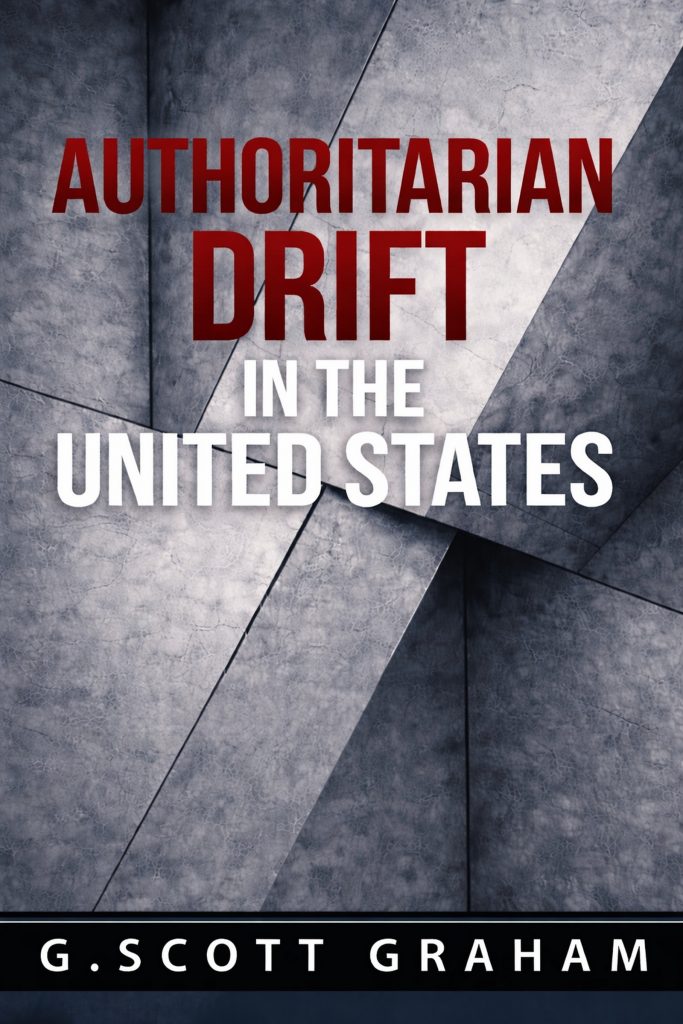
In Authoritarian Drift in the United States, G. Scott Graham examines what happens before a crisis becomes obvious, when institutions are still functioning, daily life continues, and yet something fundamental is shifting beneath the surface.
Blending political science with psychological insight, this book explores how democratic erosion is experienced in real time, not through dramatic collapse, but through gradual normalization, uncertainty, and fatigue. Drawing on the work of historians and political theorists, Graham translates large-scale political patterns into something more immediate and personal: how people perceive, adapt to, and sometimes miss early warning signs.
This is not a book about predicting outcomes. It is a book about staying oriented while things are still unclear.
Inside, you’ll learn:
- Why harmful systems rarely feel obvious while they are forming
- How normalization happens without conscious agreement
- Why clarity almost always arrives too late
- How exhaustion quietly reduces attention and resistance
- How to recognize patterns without collapsing into fear or denial
At the center of the book is a practical Early Warning Checklist, designed to help readers distinguish between private anxiety and shared reality, and to determine when attention, oversight, or action becomes necessary.
This book does not tell you what to think.
It helps you decide when watching is no longer enough.
Racheal Wallace on Amazon wrote:⭐️⭐️⭐️⭐️⭐️ Verified Purchase
The Danger of Getting Used to It
This book is a thoughtful and emotionally direct look at democratic erosion, political normalization, and public exhaustion in modern America. Blending psychology, history, and political observation, it focuses less on dramatic catastrophe and more on how harmful systems gradually become accepted over time.
One of the book’s strongest points is its ability to describe feelings many people struggle to articulate. Graham writes, “Unease is often the first psychological signal that normalization is beginning,” a line that effectively captures the book’s central theme. The author is particularly strong when discussing how exhaustion and adaptation shape public behavior. Another memorable line states, “Normalization explains how people drift, not who they are.”
The practical “Early Warning Checklist” is also one of the book’s best features, encouraging readers to track patterns involving accountability, transparency, and due process instead of reacting emotionally to headlines.
However, the book does have weaknesses. Some ideas feel repetitive, likely because the material originated as separate essays. The political perspective can also feel one-sided at times, which may limit its appeal to readers who do not already share the author’s concerns. Additionally, the emotional tone occasionally moves from analysis into activism, which can reduce the sense of objectivity.
Even with those shortcomings, I think the author succeeds in encouraging readers to stay attentive and thoughtful without surrendering to panic. It is a compelling and accessible reflection on fear, normalization, and civic responsibility in uncertain times.
Davinska on Amazon wrote:⭐️⭐️⭐️⭐️⭐️
An insightful analysis of how democratic standards might erode over time can be found in Authoritarian Drift in the United States. The author contends that a gradual departure from conventional democratic values may be indicated by changes in public opinion, institutional stress, and political action.
The book's utilization of historical analogies and actual cases to bolster its arguments is one of its key advantages. The author helps readers identify trends that could otherwise go unreported by drawing comparisons with other nations that have seen democratic regression. Because of the writing's accessibility, a broad audience can more easily comprehend complicated political concepts.
However, because the book emphasizes hazards and warning indicators more than counterarguments or systemic stabilizing forces, some readers could feel the argument to be a little biased. The study might have felt more balanced if a greater variety of viewpoints had been included.
Griffin on Goodreads wrote:⭐️⭐️⭐️⭐️⭐️
Authoritarian Drift is dense with insight yet remains perfectly readable, specifically regarding the normalization of once-unthinkable events. It masterfully tracks how our collective bar for "normal" shifts over time. With the inclusion of the "Early Warning Checklist," Graham provides a tool that is as practical as his commentary is profound.
⭐️⭐️⭐️⭐️⭐️
I picked up Authoritarian Drift in the United States because I’ve been trying to make sense of what’s happening right now, especially with Donald Trump and the growing talk about authoritarianism in America.
This isn’t just another political opinion book. It doesn’t scream “dictator” or try to force a conclusion. Instead, it walks through the actual patterns, how power shifts, how things normalize, and how people, including me, start adapting without even realizing it.
It’s hard to read this and not think about Trump in a very direct way. The book makes it pretty clear that a lot of what we’re seeing under his leadership lines up with classic authoritarian behavior. If you’re someone who’s Googling things like “is Trump becoming a dictator” or “signs of authoritarianism in the US,” this book is basically answering that question without turning it into hype.
The checklist in the back forced me to stop thinking in headlines and start looking at patterns over time.
What I appreciated most is that Scott doesn’t tell you what to see. He shows you how to see. If you’re worried about democracy, Trump, and where the country is heading, this book is worth your time.